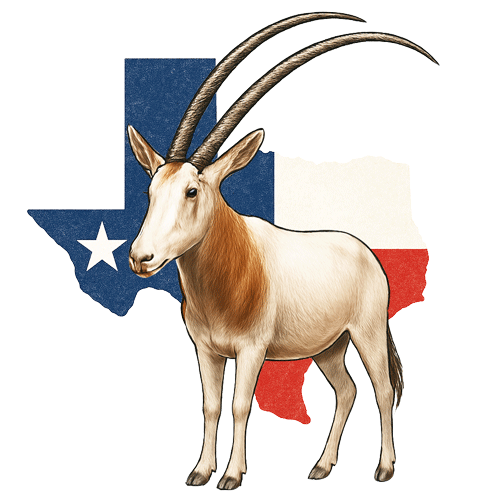
Scimitar Oryx – Scimitar Horned Oryx

Central Texas Exotic Game

The scimitar-horned oryx (Oryx dammah) is a striking North African antelope with long, curved horns, a pale coat, and a remarkable conservation story. Once declared extinct in the wild, it now thrives on private Central Texas ranches. Here is what the animal is, how big it gets, and how it is hunted near Oakalla, north of Austin and south of Killeen.
Once Extinct in the Wild

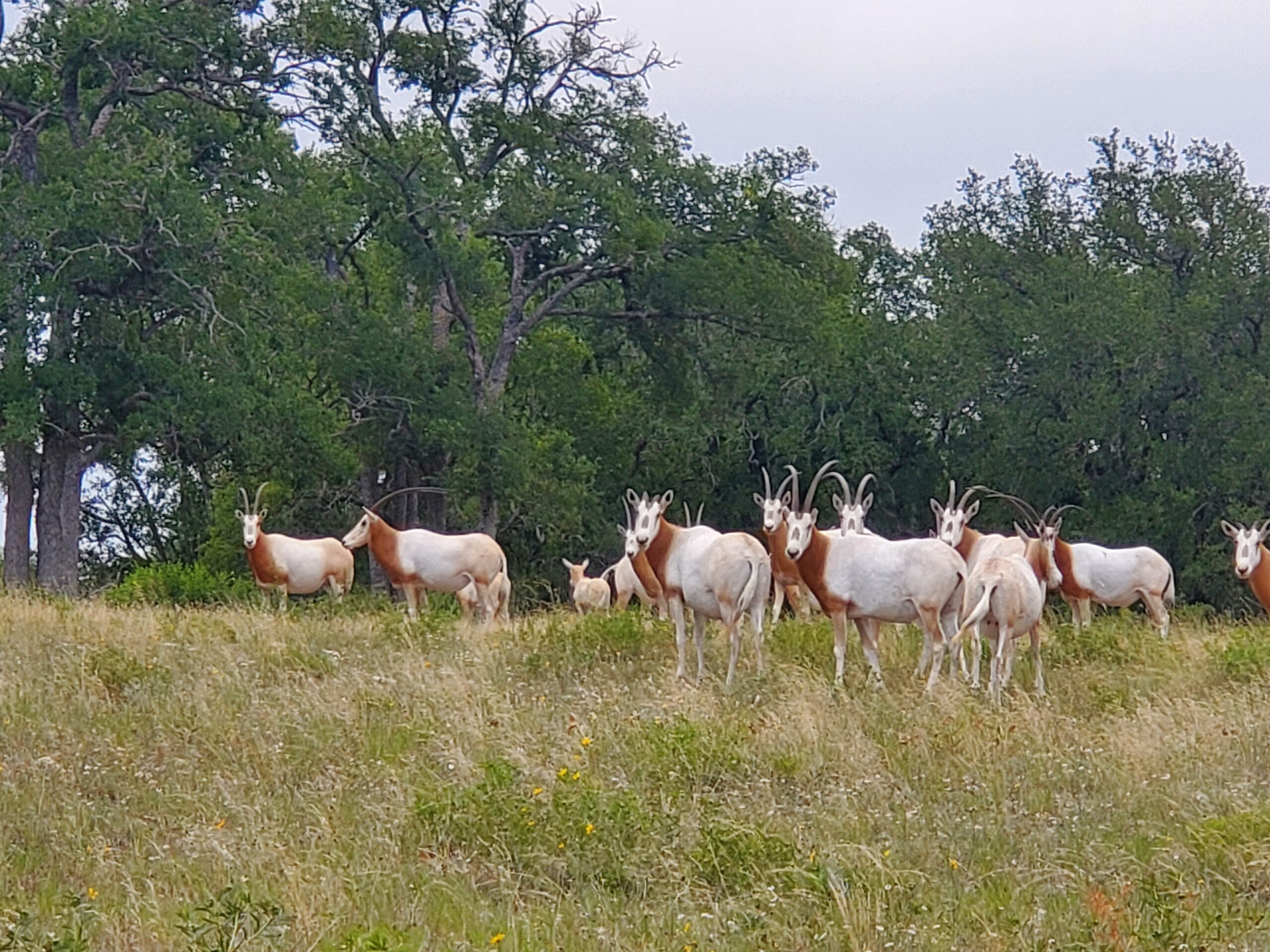
Scimitar-horned oryx herd on a private Central Texas ranch

Oryx dammah

Once Extinct in the wild. Thriving in Texas.

Declared gone from the wild in 2000. Rebuilt on private Texas range, reintroduced to Chad, and downgraded to Endangered in 2023. Here is the animal, the horns, and the recovery.

Scimitar Oryx at a Glance

Key facts about the scimitar oryx.

One of the most recognizable exotic antelope in North America. Desert-adapted and hardy, it does well in the dry, open country of Central Texas, which is why healthy free-range herds are found on private ranches across the state.

Oryx dammah

Scientific name

400 to 460 lb

Mature bull weight

30 to 40+ in

Horn length, both sexes

Endangered

IUCN status, 2023

What is a scimitar-horned oryx?

A scimitar-horned oryx is a large antelope of the genus Oryx, named for the long, backward-curving horns that resemble a scimitar blade. Both bulls and cows carry these horns, so every animal is a horned animal and, in hunting terms, a trophy opportunity. Adults have a pale, almost white coat with reddish-brown markings across the chest and face, an adaptation that once helped them reflect the harsh sun of the North African desert.

Scimitar oryx are true desert survivors. They can go long stretches with little water, drawing moisture from the plants they graze and staying active through the heat of the day when other animals bed down. That toughness is exactly why they adapted so well to the dry, open range of Central Texas.

Field ID

  • Coat: pale, almost white
  • Horns: long, curved, on both sexes
  • Build: desert-adapted, lean
  • Temperament: alert herd animal

Once extinct in the wild. Now thriving on Texas range.

By the Numbers

~4 ft
Shoulder height

400 to 460 lb
Mature bull weight

36+ in
Top-tier trophy horn

Appearance, size, and horns.

A mature scimitar oryx bull stands roughly four feet at the shoulder and weighs about 400 to 460 pounds, with cows slightly lighter. The signature feature is the horn: long, ringed, and sweeping back in a smooth curve. Horn length commonly runs 30 to 40 inches, and exceptional trophy bulls exceed 36 inches, the threshold for a top-tier trophy on most Texas ranches.

Because both sexes are horned, hunters can pursue a mature bull, a representative cow, or a management animal depending on their goal. On this ranch that maps directly to the meat, mature, and trophy hunt options.

A Conservation Success Story

From extinct in the wild to thriving Texas herds.

The path from the Sahara to Central Texas and back to the wild is one of the clearest modern examples of conservation through sustainable use.

01

Vanished from the wild

Overhunting, habitat loss, and desertification collapsed wild populations across the Sahara and Sahel through the twentieth century. In 2000 the IUCN declared the species Extinct in the Wild.

02

Saved on Texas range

Private ranches, many in Texas, became an unlikely ark. Decades of careful breeding built large, genetically diverse Scimitar Horned Oryx herds strong enough to seed a recovery.

03

Returned to the wild

Animals descended from this stock were reintroduced to Chad beginning in 2016. In 2023 the scimitar-horned oryx was reclassified from Extinct in the Wild to Endangered.

Behavior, diet, and lifespan.

Herd behavior

Scimitar oryx move in loose herds led by a dominant cow. Bulls spar for status with low-level horn displays. They are diurnal and alert, which makes a patient spot-and-stalk approach both effective and rewarding.

Diet and hardiness

Their diet is grasses and browse, and they are built to handle dry seasons that would stress other antelope. That desert toughness is exactly why they thrive on open Central Texas range.

Breeding and lifespan

Breeding can occur year-round in a suitable climate, with a single calf after a gestation of roughly nine months. On well-managed ranches, scimitar oryx can live up to 20 years.

Scimitar oryx vs gemsbok: what is the difference?

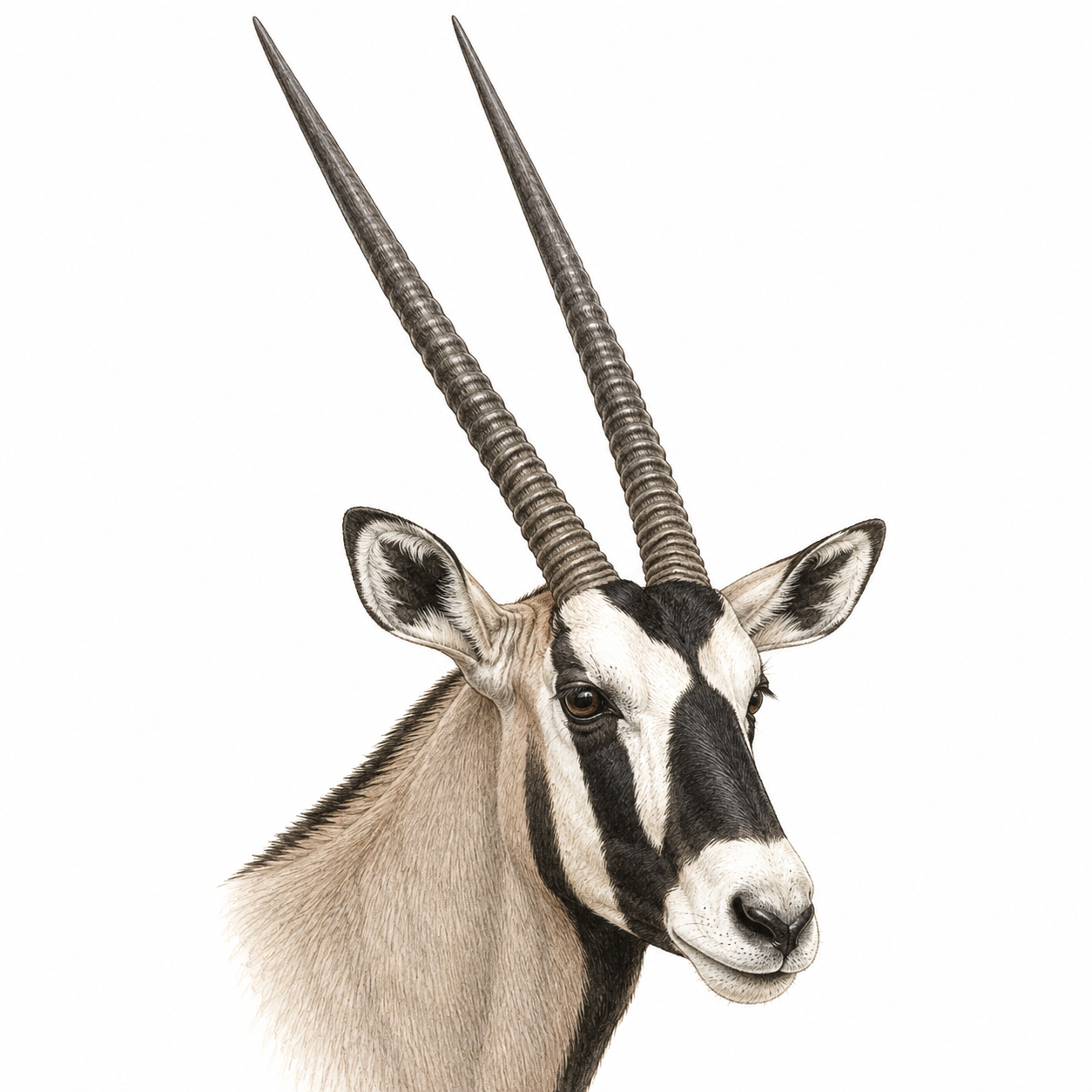
People often confuse the two because both belong to the genus Oryx. The tell is the horns: if they curve, it is a scimitar oryx; if they run straight as spears, it is a gemsbok.
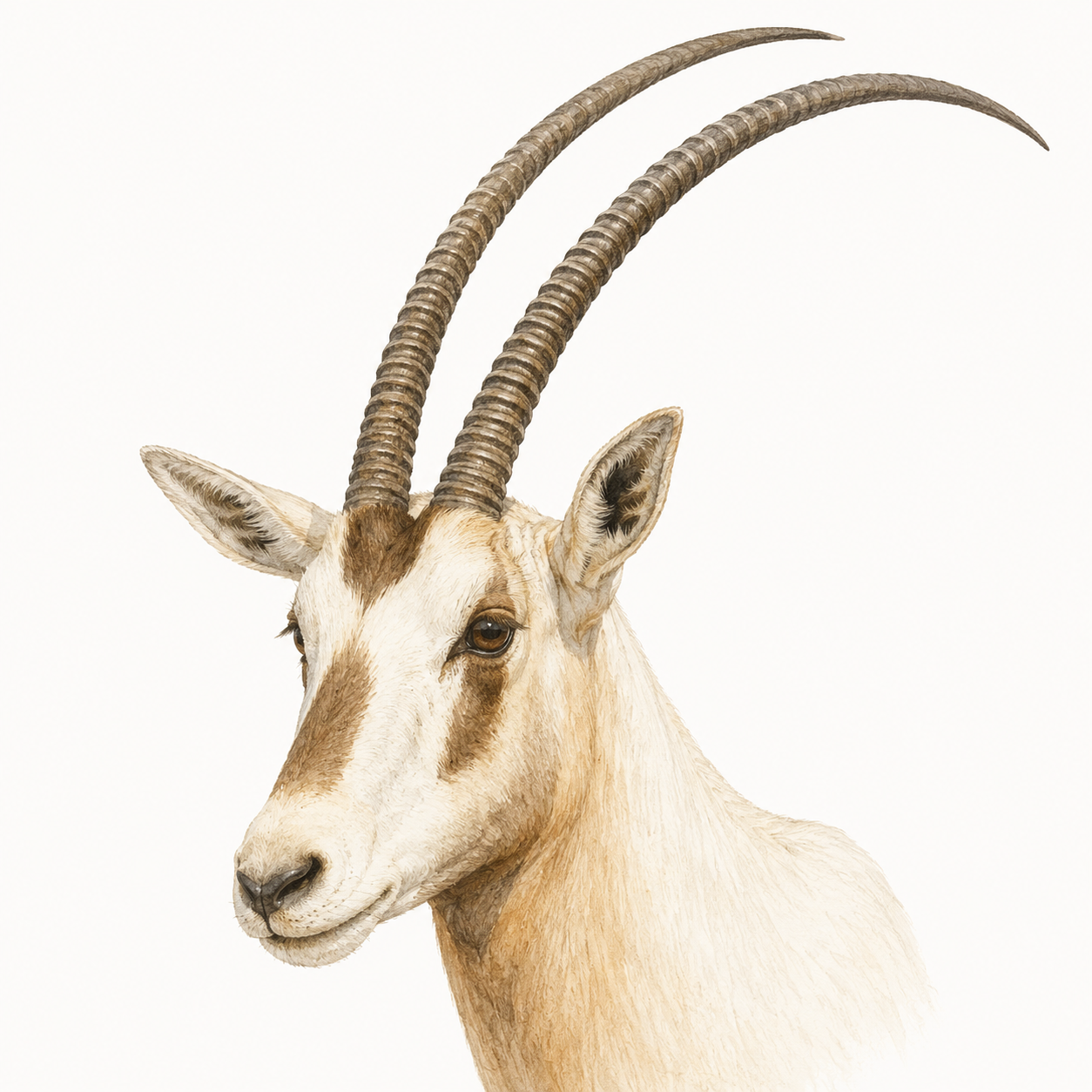
Scimitar-Horned Oryx

Origin: North Africa (Sahara, Sahel)

Coat: pale to nearly white

Horns: long and curved, both sexes

Species: Oryx dammah

Gemsbok

Origin: southern Africa

Coat: grey with bold black markings

Horns: long, straight, rapier-like

Species: Oryx gazella

Hunt the Species

Hunting scimitar oryx in Central Texas.

Scimitar oryx are exotic game in Texas, which means they can be hunted year-round with no closed season and no bag limits. A valid Texas hunting license is required, and that is all: no drawn tags, no lottery. This ranch offers free-range, spot-and-stalk hunts near Oakalla.

Oryx also delivers outstanding table fare. The meat is lean, mild, and lower in fat than beef, which is why meat hunts are so popular. To see how a hunt runs, from shot distances to what is included, read the scimitar oryx hunt details, then contact the ranch to check current availability.

Three Ways to Hunt

Meat Hunt
from $1,750 · broken or no-horn oryx

Mature Oryx
$3,500 · 30 to 36 inch class

Trophy Bull
by availability · over 36 inches

Scimitar oryx: frequently asked questions.

A scimitar-horned oryx (Oryx dammah) is a large North African antelope named for its long, backward-curving horns. Both bulls and cows carry horns that often exceed 40 inches. Once native to the Sahara and Sahel, the species now thrives on private Texas ranches.
Mature bulls stand roughly four feet at the shoulder and weigh about 400 to 460 pounds, with cows slightly smaller. Horns commonly reach 30 to 40 inches or more, and exceptional trophy bulls exceed 36 inches.
The IUCN declared the scimitar-horned oryx Extinct in the Wild in 2000. Captive breeding, much of it on Texas ranches, allowed reintroduction to Chad, and in 2023 the species was reclassified from Extinct in the Wild to Endangered.
Both belong to the genus Oryx. The scimitar-horned oryx is pale to white with long curved horns and comes from North Africa. The gemsbok (Oryx gazella) is grey with bold black markings and straight, rapier-like horns, and comes from southern Africa.
Oryx is lean, mild, and tender, lower in fat and cholesterol than beef. Many hunters compare it favorably to elk or grass-fed beef, which is why meat hunts are popular.
Yes. Scimitar oryx are hunted year-round on private Texas ranches as free-range exotic game. A valid Texas hunting license is required, but there are no seasons or bag limits on exotics, and regulated hunting funds the herds that sustain the species.
Texas ranches began keeping scimitar oryx decades ago because the dry, open range suits these desert-adapted animals. Sustainable-use hunting funds the habitat and herd management that keep populations healthy and growing.